 Dobbelt Op
2048 on 5×5, 3×3 and 6×6
A 5×5 board has 25 cells instead of 16. The rules stay the same and the corner strategy still works, but there's so much more room that the 2048 tile comes far more easily and the game can go on much longer. A 3×3 board is the opposite: nine cells can't hold a 2048 at all, and 1,024 is the highest tile you can make. On 6×6, 2048 is only the warm-up.
Board size and the highest tile possible
3×3
9 cells
Highest possible tile
1,024
4×4
16 cells
Highest possible tile
131,072
5×5
25 cells
Highest possible tile
67,108,864
6×6
36 cells
Highest possible tile
137,438,953,472
The highest tile on each board
One rule covers every size. At best, each cell holds a different tile in one long line from the corner, with two 4s at the end. Fold the line up and you get a single tile worth 2 to the power of (cells + 1). On the standard 4×4 board that's 131,072.
Past 4×4 the numbers get silly fast, so the ceiling stops mattering: in practice the board size decides how much room you have for mistakes.
Playing on 5×5
Play it as you'd play 4×4: pick a corner, swipe mostly in the two directions that push towards it, and line the numbers up from big to small along one edge. The difference is the spare room. A row is five tiles long, so one stray 2 doesn't wreck your chain, and there's usually a free cell somewhere to fix a mistake.
Every swipe adds one new tile, and a 2048 is built from around 930 of them, so reaching it takes at least that many swipes on any board. What changes on 5×5 is that you rarely run out of room on the way, and the game carries on to 4096 and 8192 if you have the patience.
Playing on 3×3
Nine cells make 1,024 the ceiling, and even that needs every tile to end up in exactly the right order, with a 4 landing in the right cell at the very end. A 512 is a good game. Every swipe counts, because one 2 in the wrong cell can lock the board for good.
The 3×3 board at its limit
So if you came here to find out how to make 2048 on 3×3: it can't be done, and it isn't you.
6×6 and bigger
With 36 cells you can play loosely for a long time. The early game is mostly sweeping tiles together, and 2048 turns up before the board starts to feel full. The hard part is patience: a 16,384 is built from about 7,400 new tiles, so it takes at least that many swipes.
Bigger and smaller versions of 2048 exist as browser games and apps, and Wikipedia mentions them among the game's adaptations. Gabriele Cirulli's original is 4×4. If you're playing that one, how to win 2048 covers the strategy.
Dobbelt Op's Daily board: 5×5, cut to shape
I made Dobbelt Op, a number puzzle for iPhone, and its Daily board is my favourite take on 5×5. It isn't a plain 5×5, though. Every day it's cut into a new shape that keeps 16 to 21 of the 25 cells, with grey stones that never move and never merge. You get a goal (128 on Monday, up to 512 at the weekend) and a limited number of moves, with no undo.
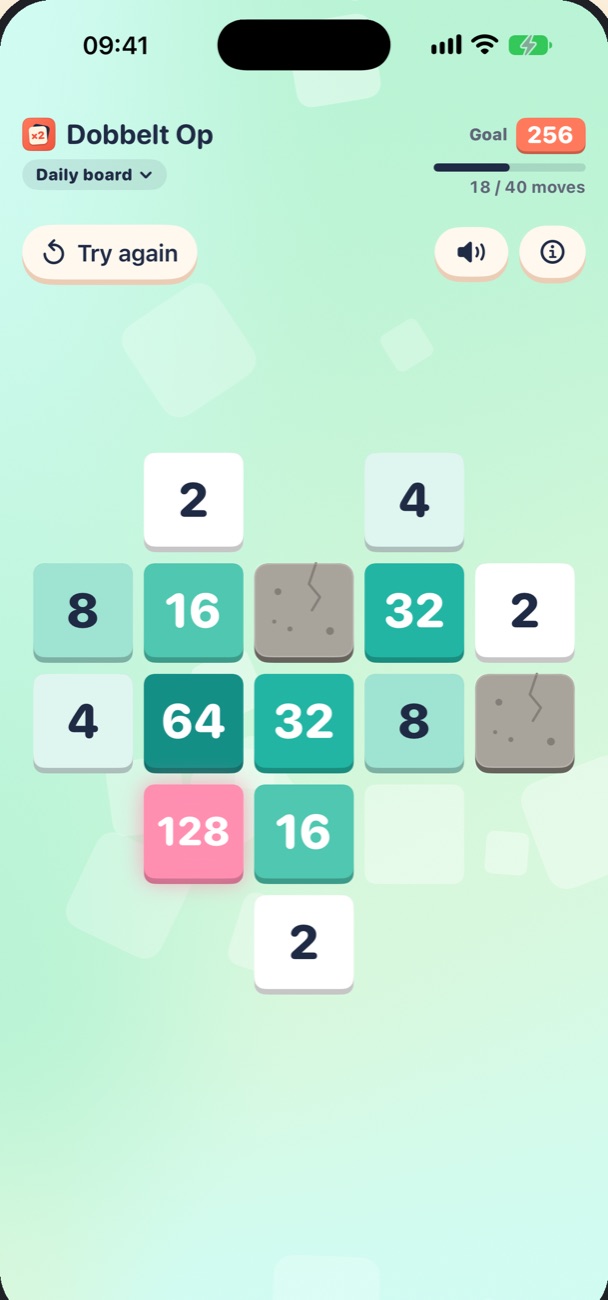 15×5, cut into a new shape every day2Stones never move or merge
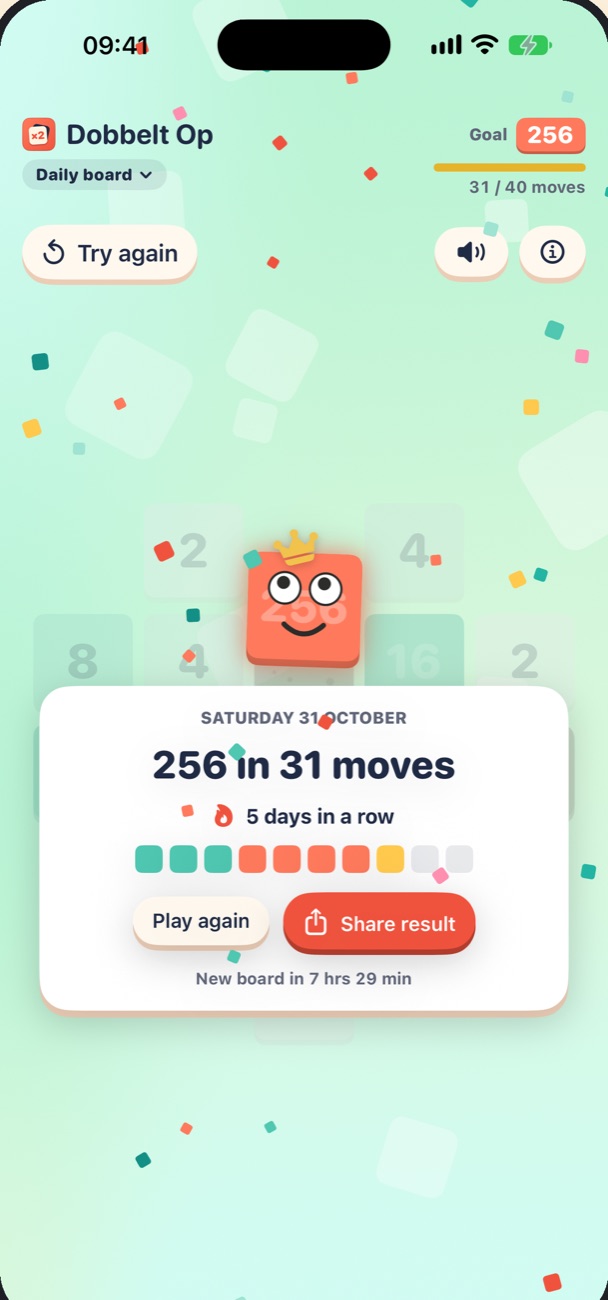 3Goal and moves used4Solved: the same board for everyone
- 5×5, cut into a new shape every day
- Stones never move or merge
- Goal and moves used
- Solved: the same board for everyone
With the stones and the odd corners taking room away, it often plays as tight as a 4×4. The shape decides where your corner goes, and a stone makes a good wall to build against. Everyone gets the same tiles in the same order that day. The other modes, With attitude among them, use the classic 4×4 board.
Dobbelt Op costs $2.99, once. No ads, no account and nothing to buy.